


Note: Just a note on my recent silence. I have had 3 conferences in the last several days and three papers to prepare and present, so I have had no time to write. I will begin to come up for air next week. I had started the post below a few weeks ago, and just got some time to finish it.
***
1. Leo on The Church’s Mission in the Contemporary World
In Pope Leo XIV’s General Audience of October 7, 2026, he gave his fifth reflection on the Second Vatican Council’s Pastoral Constitution on the Church in the Modern World: Gaudium et spes. In so doing, he focused on The mission of the Church in the contemporary world (GS, 40-45). The whole short audience merits reflection as Leo fosters the reception of Vatican II and his Magnifica Humanitas, so I will cite most of it before offering some illustrations that I am developing for teaching purposes.
First of all, the Council recalls that the Church is not “above” or “beside” the world, but is, as it were, grafted into it. “Mundus reconciliatus Ecclesia”, wrote Saint Augustine (Sermon 96): the Church is the world already reconciled with God; we are pilgrims on earth and share in this world’s fragility and beauty (cf. GS, 40).
This love and commitment to this world merits note in light of some books I have been listening to during my recent travels that explain the frightening mentality that is common among the “tech bros,” who have an apocalyptic vision where they want to not only transcend humanity but earth. I hope to return to this. Leo’s audience continues.
Just as the Son of God was incarnated to give life to the world and to reconcile it with the Father, so the Church dwells in the world as a sign of the incarnation of God, in order to manifest His plan to make us all His children in one great human family. Therefore, the Church journeys through history in the midst of peoples and cultures, and “this involvement in people’s lives helps the Church understand ever more clearly that her mission has a historical scope and entails a responsibility for the way in which social relations are built” (Encyclical Letter Magnifica Humanitas, 19).
Here we see the incarnational vision of Catholicism, according to which the Church is the continuation of the incarnation in space and time. God has a plan, and it is quite contrary to that of some of the most powerful people on earth, but as MH no.1 states, we need to make the “pivotal choice” to get to work on doing our part to realize that plan. The Church walks in solidarity with the human family. We are not, however, here just to live a pious life, but recognize that our “mission has a historical scope and entails a responsibility for the way in which social relations are built.”
The first mission of the Church is to help people be attentive to the profound questions of life: those concerning our origin and our destiny, as well as those concerning the meaning of love and suffering (cf. GS, 41). The logic of profit at all costs and the manipulation of information risk exerting undue pressure on people to conform to a lifestyle centred on the consumption of material goods, but our hearts are made to look upwards.
Through our witness and words, we need to awaken people to the fact that human life has profound meaning.
The Council Fathers remind us that the Church’s mission is fulfilled also in contributing to the construction of the earthly city. However, her methods and aims are not primarily of a political order; rather, they consist in bearing witness to faith and charity, together with commitment for justice, peace, and fraternity.
The first priority of all Catholics is a witness of faith, hope, and charity. And of course, the methods and aims of especially the clergy “are not primarily of a political order,” although the laity do have an apostolic calling to inform it with the spirit of the Gospel. The common priority on faith, hope and charity goes together—therefore—with an active “commitment for justice, peace, and fraternity,” with all Catholics doing their own part.
By worshipping Christ, the Righteous One who died for the unrighteous, the believer cannot accept the oppression of the weak and the poor, nor the unjust structures that perpetuate conditions of dependence and injustice. The social doctrine of the Church guides the actions of Christians, who collaborate with all people of good will in promoting the common good. The Church, therefore, “has no fiercer desire than that in pursuit of the welfare of all she may be able to develop herself freely under any kind of government which grants recognition to the basic rights of person and family, to the demands of the common good” (GS, 42).
Just like Jesus who came to preach good news to the poor, “the believer cannot accept the oppression of the weak and the poor, nor the unjust structures that perpetuate conditions of dependence and injustice…” Catholic social doctrine guides us in doing so.
…Gaudium et Spes reserves special mention (cf. ibid.) for the mission of the lay faithful who, by virtue of their Baptism, are called to enliven the world with the Christian spirit and the vision of the Gospel. The principal settings for this activity, which may well be described as priestly, are undoubtedly the family and the workplace, but it extends to every sphere of life.
In speaking of the Church’s mission in the world—one that urgently needs to be renewed—Pope Leo wisely refers to the Apostolate of the Laity, to which I return below.
Finally, the Church is always attentive to what is taking place and developing in society (cf. GS, 44). It is the task of the whole People of God, especially pastors and theologians, to discern what in the cultures of our time is worthy of consideration, always taking the Word of God and the Tradition of the Church as the supreme criteria for discernment.
Here Leo echoes the call of Magnifica Humanitas to enter into a shared discernment regarding the signs of our times, with the encyclical providing his contribution to this communal discernment. To do so will require the Church to recover the great riches of our social doctrine, to which this whole substack and related efforts are dedicated.
Leo concludes.
Dear friends, as she journeys through history, “the Church has a single intention: that God’s kingdom may come, and that the salvation of the whole human race may come to pass” (GS, 45). She strives towards this end above all through personal holiness and fraternal love. Saint Paul VI wrote: “Without this mark of holiness, our word will have difficulty in touching the heart of modern man. It risks being vain and sterile” (Apostolic Exhortation Evangelii Nuntiandi, 76). Let us therefore be open to the action of the Holy Spirit, that He may help us to live in holiness and charity, so that the world may believe and hope.
2. Lay Apostolate Realizing the Call of Magnifica Humanitas
If Leo’s Magnifica Humanitas call to build a civilization of love is to be realized, I continue to argue that we need to realize the promise of the Second Vatican Council’s Apostolate of the Laity. The Council draws on various New Testament and traditional insights to articulate this apostolate. It envisions laity acting as leaven in the world, working in every segment of life to inform it with justice and a spirit of fraternal charity.
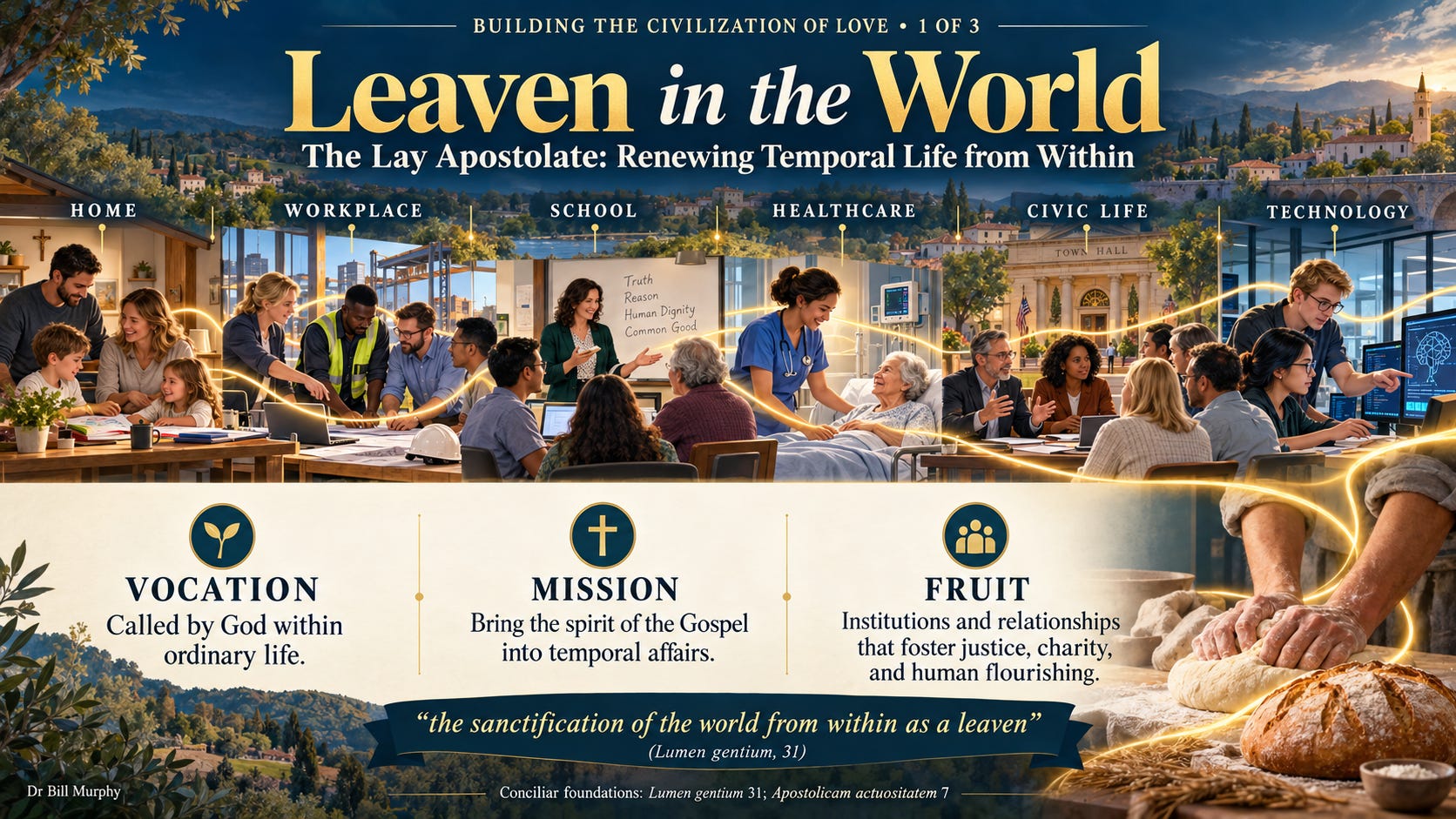
As was well-exemplified through generations of what was often called Specialized Catholic Action, Catholics take it as their apostolic calling to inform their spheres of influence with that christian spirit, guided by the principles of Catholic Social Doctrine. As members of what St. Augustine called the totus christus—the whole Christ—they join the offering of these apostolic works with the salvific offering of Christ in the eucharist, thereby drawing upon the power of Christ’s resurrection to consecrate the world to God.
As no. 34 of the Dogmatic Constitution on the Church: Lumen Gentium puts it:
34. The supreme and eternal Priest, Christ Jesus, since he wills to continue his witness and service also through the laity, vivifies them in this Spirit and increasingly urges them on to every good and perfect work.
For besides intimately linking them to His life and His mission, He also gives them a sharing in His priestly function of offering spiritual worship for the glory of God and the salvation of men. For this reason the laity, dedicated to Christ and anointed by the Holy Spirit, are marvelously called and wonderfully prepared so that ever more abundant fruits of the Spirit may be produced in them. For all their works, prayers and apostolic endeavors, their ordinary married and family life, their daily occupations, their physical and mental relaxation, if carried out in the Spirit, and even the hardships of life, if patiently borne—all these become “spiritual sacrifices acceptable to God through Jesus Christ”.(199) Together with the offering of the Lord’s body, they are most fittingly offered in the celebration of the Eucharist. Thus, as those everywhere who adore in holy activity, the laity consecrate the world itself to God.
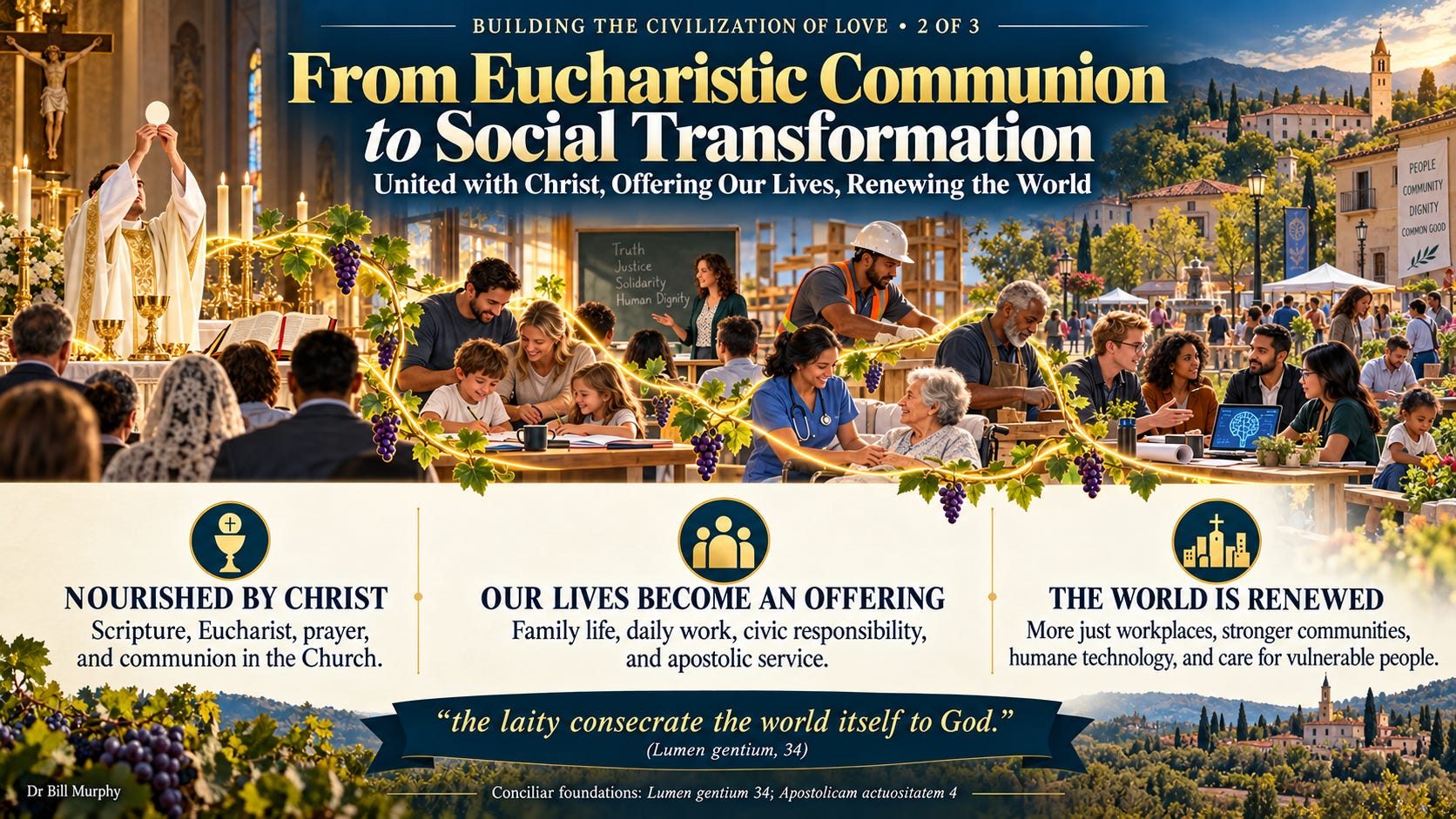
Understanding themselves to be members of the mystical body of Christ, all Catholics—including the clergy who form and nourish the laity for their apostolates, and religious who provide essential support—work to build the Civilization of Love.
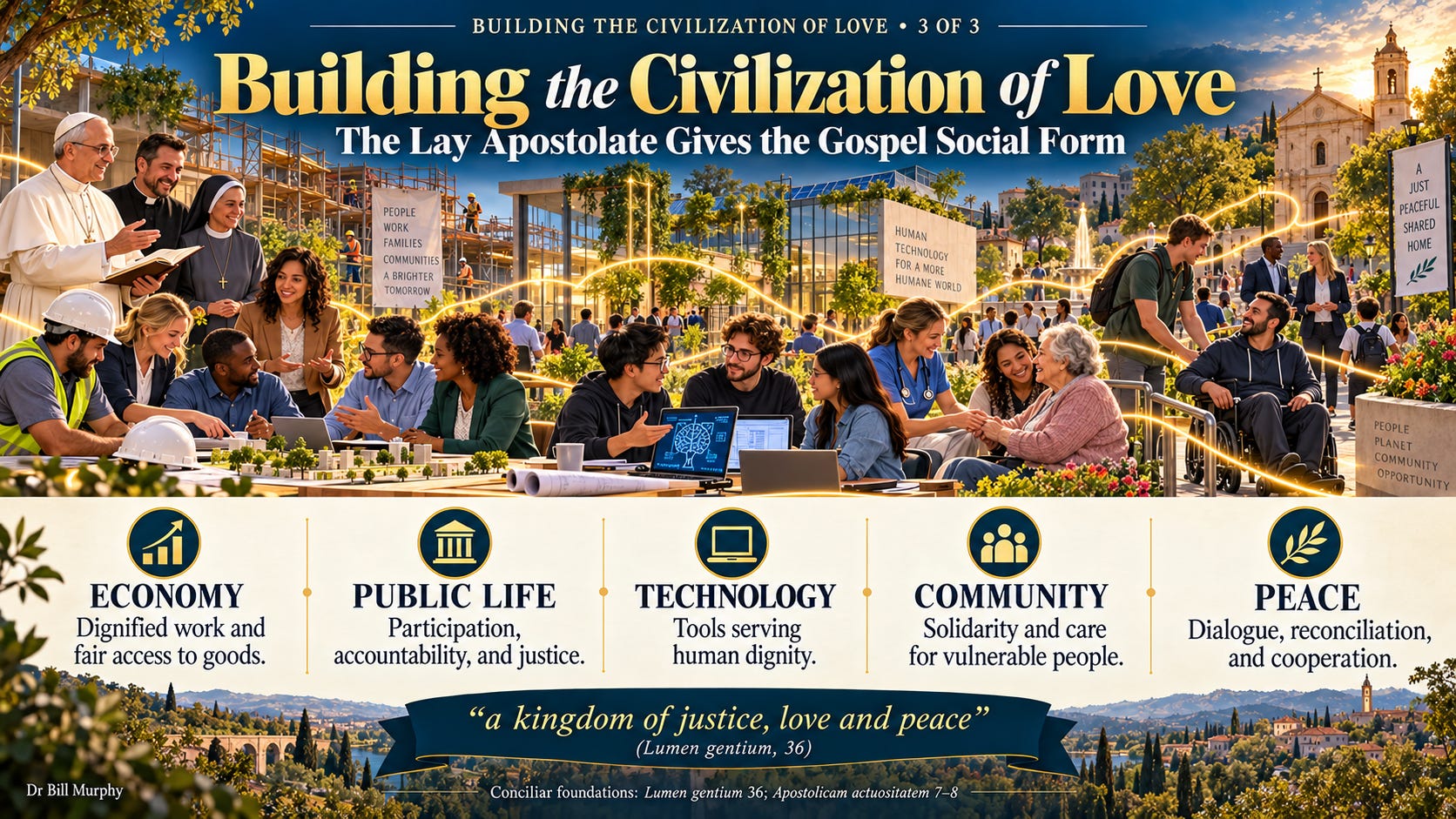
To realize this Gospel mission in the world, we need to communicate it to laity and support them in living it out. This will require building and renew ministries and movements toward this end. This will require the support of clergy. A good place to start is with substantial programs dedicated to the study of Magnifica Humanitas, with an orientation toward realizing its call.