

Debating Postliberalism
A journal issue dedicated to discussing the current debate

As Donald Trump continues his rampage through the institutions of what have been known as American liberal democracy and the postwar liberal order, some of the most erudite academics are vigorously debating the geneology, varieties, and content of the “postliberal” thought that has both prepared for—and arguably fostered—this frightening change of orders and now accompanies it.
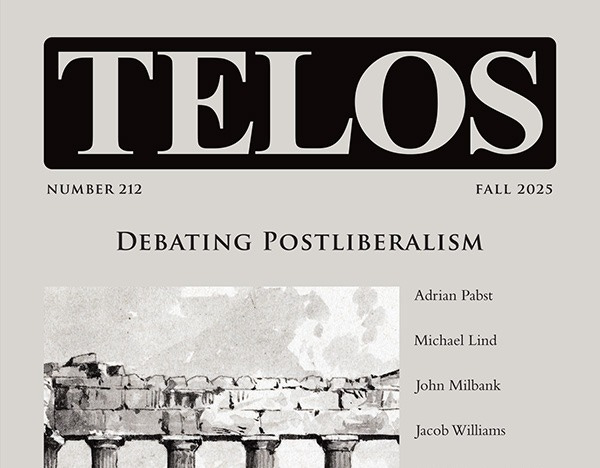
As I treated in a recent post, discussions of postliberalism presuppose that we define what we mean by the liberalism that it supposedly follows, especially because postliberals often define liberalism in ways that are most vulnerable to criticism. In any case, a noteworthy collection of essays on the theme of “Debating Postliberalism” was recently published in the Fall 2025 issue of Telos, a journal that was originally founded in 1968 as a venue for the New Left, but turned to the right in the 1980s. The journal issue can be expected, therefore, to give a thorough and sympathetic reading of a phenomenon of the contemporary right. The website for the journal includes an open access introduction to this issue by Adrian Pabst, who is Honorary Professor of Politics at the University of Kent, UK. I include that below.
I read such debates as someone working from the theological perspective of the Catholic social tradition, so I add some comments [i.e., WFM: comments…] reflecting observations, objections, or questions that come to mind when reading about the interventions of these thinkers, at least some of whom are of considerable repute. Because I am especially interested in the institutions that shape our shared life, I read such literature on postliberalism in light of my preference to speak about constitutional democracy, and following my understanding that the neoliberal economic paradigm that took hold in the 1980s is economically, politically, and environmentally unsustainable.
Introduction by Adrian Pabst: His Prologue
The introduction by Pabst begins as follows, with my comments either following the block citations or imbedded in brackets.
In 1998, Alan Wolfe remarked that “the right won the economic war, the left won the cultural war, and the center won the political war.” It was the age of triumphant liberalism, freed from the shackles of the Cold War confrontation between the capitalist West and the Communist East. Capitalism was now the uncontested model, as Western countries increasingly abandoned a more embedded social market economy in favor of the global market-state while emerging market economies embraced the state-market.
Great start. Yes, the right won the economic war with the shift in the 1980s to what came to be called the “neoliberal” economic paradigm. I only wish he had used that term, especially since a good case has been made that the failure of this paradigm should have been evident by at least the 2008 financial crisis. For this reason, work proceeds toward a new economic paradigm that better serves the broad population to be politically and economically sustainable. Continuing the introduction by Pabst.
In each case, society was the loser. Even as countries converged internationally and China morphed into an economic powerhouse, asset and income inequality increased within countries, and so did regional disparities—between the former heartlands of the Rust Belt and the new metropolitan hubs exemplified by Silicon Valley. Building on the writings of Paul Piccone and Christopher Lasch, critics of liberalism such as Christophe Guilluy, Nancy Fraser, Michael Lind, and Quinn Slobodian have highlighted the growing gulf between elite enclaves and peripheral wastelands, or hubs vs. heartlands, but their analysis has mostly been dismissed as nostalgic or downright reactionary. Something similar applies to politicians on both sides of the spectrum who have questioned liberal economics—whether Pat Buchanan in the past or JD Vance and Josh Hawley more recently on the Republican right, or Bernie Sanders, Ro Khanna, and Chris Murphy on the Democratic left.
I wish he had identified Quinn Slobodian more specifically as a critic of the neoliberal economic paradigm, and that he had used that word to describe the paradigm that “politicians on both sides” oppose. This choice of terminology is characteristic of postliberals—who are predominantly social and cultural conservatives who want to locate our contemporary “polycrisis” in a broad and sinister understanding of “liberalism.” In my opinion, this way of framing the question opens the door to a broad attack that also undermines the institutions that Nobel Prize-winning scholarship in political economy has shown to be integral to the common good, a key point that aligns with the Catholic social tradition.
Some political and policy differences notwithstanding, the mainstream left and right—in the United States, Europe, and other Western countries such as Japan, South Korea, Australia, and New Zealand—took a progressive turn [WFM: this is a strange framing in terms of “progressive,” which is a trigger word on the right] and embraced untrammeled markets, hyper-individualism, and foreign military adventures. The ruling elites felt vindicated by the “end of history” utopia of a global convergence toward liberal market democracy and the inevitable forward march of globalization.
“Ruling elites” is another a loaded term of the populist right, so this terminology signals who is the enemy. The reference to the “end of history’ is a common reference to an early work of Francis Fukuyama, whose position was actually more nuanced than normally recognized, and who has subsequently written many substantial books that are more relevant to our situation.
Pabst continues that “Both liberal interventionists and neoconservative crusaders advanced the vision of America as a liberal Leviathan that secures the social contract at home and U.S. supremacy abroad.”
The terminology Pabst employs can give the impression that this was a symmetric problem, but the “liberal interventionists” and “neoconservative crusaders” he mentions were both exemplified by the Republican Administration of George W. Bush, even if their deception on WMDs helped secure some Democratic support for the 2003 Invasion of Iraq. His narrative continues.
Yet the triumph of liberalism was brief. Already in the 1990s there were signs of disorder in the Balkans, a growing backlash against the global free market, as well as a resurgence of both nationalism and religious fundamentalism. Since the 2003 Iraq invasion and the 2008–09 financial crisis, the post-1989 liberal model is facing a deepening crisis of legitimacy. Across the West, populists on the far left and on the radical right are challenging the political status quo defended by center-left and center-right parties. Brexit and the first Trump victory marked the moment the old establishment lost in two major Western countries.
Populism is not just a blowback against the social disruption produced by progressive policies.
Note how Pabst’s framing shifts the blame for the problems caused to “progressive policies.” I would argue that they trace much more to the combination of neoliberal economics, the network of think tanks and media ecosystem funded by the oligarchs who benefit from this economic paradigm, and the angry hard right actors they inspire. Pabst continues: “Populists also re-politicize issues that the liberal left has sought to exclude from political contestation, such as globalization, legalism, and mass immigration.”
For an article published in late 2025, I think describing the “liberal left” in this way is highly misleading. It overlooks the fact that the consensus on the American left since the 2020 Biden campaign has been on advancing a “middle-out” economics that was focused on rebalancing the economy so the security of a middle-class existence could be broadly achievable.
Pabst continues: “These have become impersonal forces imposed upon ordinary people who feel overwhelmed, their fears and anxieties dismissed, ignored, even ridiculed.”
I find this widespread postliberal attribution of blame to “impersonal forces” unconvincing because these realities have resulted from human agency, from persons and groups advancing ideas and policies, generally those that foster the wealth and power of the wealthy. To the extent the resulting socioeconomic conditions and structures are contrary to justice and human flourishing, they reflect what Catholic social teaching speaks of as “structural sin.” The central for Catholics to live out our apostolic calling to inform the temporal order with the spirit of the gospel, informed by Catholic Social Doctrine. This vision of the Second Vatican Council has been largely ignored, however, as increasing numbers of Catholic instead followed a sociopolitical agenda conceived by Republican political operatives, and funded by the conservative donor network. This was aided by the fact that, since the 1990s, radically radically antiliberal sociopolitical views—foreshadowing what came to be called postliberalism—have been propagated which discourage Catholic political participation by railing against liberalism being rigged against us.
Pabst continues that “In 2016 Hillary Clinton said that half of Donald Trump’s supporters belonged in a ‘basket of deplorables.’ Eight years later, Joe Biden referred to Trump’s supporters as ‘garbage.’”
This reads like blaming the left and ignoring the fact that the Democratic party largely abandoned neoliberalism and embraced a middle-out economics several years ago. It also ignores the fact that the hard right coalition is deeply populated by those espousing an individualism that disdains the common good, racism, anti-semitism, Christian nationalism, neo-Nazism, and various strains of anti-humanism.
Pabst continues.
Yet once in power, right populists deploy similar methods of demonizing their opponents and counter-canceling ideas and voices. This reveals an illiberal and increasingly antiliberal turn among both left-wing progressives and right-wing populists, who conspire to have free thinkers canceled, debate stifled, old campaigns relitigated, and lawfare deployed.
Even if I reject both the illiberal right and the illiberal left, I think this “bothsides” framing is highly misleading, and that it is more accurate to say that the far greater threat is from the long tradition of the illiberal right, and that this is inseparable from the rise of global autocracy. Pabst transitions to his introduction of the contributions in the journal issue. “In this issue of Telos, we explore the limitations of liberalism, the rise of antiliberal forces, and the emergence of postliberal alternatives through a number of essays and book reviews.”
Pabst Introduces the Contribution of Michael Lind
In the opening essay, Michael Lind argues that the contemporary debate about liberalism—its limitations but also its endurance—misses a fundamental recognition. What many critics as well as defenders of liberalism tend to overlook is the possibility that liberalism—in the economy, in politics, and in culture—will prove to be unstable and self-liquidating.
I would need to read his essay, but I don’t yet have access. Of course, everything depends on how one defines liberalism. If it is defined as an ideology of unconstrained freedom, then I would agree that it is unstable and self-destructive. I do not think that is a proper description of the United States, or constitutional democratic states in general.
Again, I think the fundamental problems with what are referred to as liberal states begin with the unsustainability of the neoliberal economic paradigm that was embraced in the 1980s, channelling wealth and political power upward. Beyond that, a range of illiberal actors have leveraged the power of social media to bring us to the edge of dystopia. I also think that at least some postliberal intellectuals have been a crucial part of the conservative coalition that is working to transform American democracy into an illiberal regime, analogous to how an alliance of conservative forces weakened the German Weimar Republic, paving the way for the Nazi Party seize power. Following the last year of attacks by the Trump Administration on our public institutions, and with the House, Senate, and Supreme Court largely failing to support constitutional government, the United States now scores just 57/100 on a new Democracy Meter.
Continuing with Pabst:
To put it another way, a liberal social order may be an ephemeral transition from one nonliberal system or regime to another. That is because radical individualism and unchecked markets corrode the very foundations of society, leading to a backlash and a corrective.
I think the backlash narrative—which has been central to conservative discourse from the New Right of the 1960s to today’s “hard right”—merits critical scrutiny. This will show that it was cultivated by Republican Party political operatives like Paul Weyrich and Connie Marshner since especially the 1970s. It functioned to conceal an illiberal political agenda of social and cultural conservatism that has roots in the paternalism of the preconciliar Catholic tradition, and is advanced to the present day, largely in dissent from the integral and solidary Christian humanism of Catholic Social Doctrine.
Continuing with Papst:
Two of the possible alternatives to liberalism in the West, democratic socialism and distributism, are doomed to remain irrelevant. An updated version of pluralism, including tripartite labor-business-government arrangements, adapted to the conditions of particular countries and blocs, is the only kind of nonliberal governance [WFM: I’m skeptical of this assertion and wish he provided a link to a further argument] that can provide a plausible alternative to both liberalism and the sort of nonliberal successor regime characterized by oligarchy and generalized corruption into which liberalism over time is likely to decay.
I wish Pabst had simply acknowledged that this “nonliberal successor regime characterized by oligarchy and generalized corruption” is precisely what we got with the illiberal right of the Trump Administration.
Pabst Introduces John Milbank’s Contribution
Pabst proceeds to discuss the contribution of John Milbank, whose intellectual project has had affinities with postliberalism for decades.
John Milbank reminds us that liberalism was invented in the seventeenth-century West in the course of what historians have long since come to call a “general crisis.” Today, we seem to be facing another and more global general crisis as we enter a new era that can in one sense be considered to be postliberal, since popular forces are effectively rejecting the upshots of both extreme economic liberalism and extreme cultural liberalism.
In especially the United States, I would agree that populist forces on especially the left—but also the right—have been angry with “extreme economic liberalism.” Even if I reject “extreme cultural liberalism,” I think the opposition to it by the populist right needs to be understood in terms of the intellectual and media ecosystem funded by the oligarchs, which stokes anger against sexual minorities and the left. This leads them to support the right, thereby empowering aspiring oligarchs and autocrats.
The solution to the first general crisis has run its course, and the attempt to substitute formalities and formal barriers for the real political work of psychic shaping has failed. Just as no corporatism and no tripartition are naturally impossible, equally no hierarchy is impossible if any sociopolitical order is to be achieved, as Marx himself insisted.
This summary is very abstract with multiple double-negatives, so I would want to see Milbank’s text to better understand what he means. He seems to distrust liberal structures in favor of a more organic and corporate society inspired by the medieval guilds. He apparently also seeks a recovery of political participation, which he thinks will require a degree of hierarchy.
So just as only a good corporatism can drive out the bad, and only a postliberal social tripartition [three-part government?] can overcome positivist tripartition and an overextended and inflexible division of labor, so too only a good hierarchy of virtuous guidance at every level, allied to democratic feedback, can overcome the bad hierarchy of money and manipulation.
For Milbank, a ‘good’ or Christian corporatism—as opposed to an individualist society—“recognizes the priority of the social, the community, and intermediary institutions over both the individual and the central state. Milbank advocates for a ‘social corporatism’ or corporatist cooperative economy to replace the destructive, unbridled nature of liberal capitalism and the bureaucratic state.” If by Christian corporatism, he were to mean an integralist state, I would disagree. If he means a secular society infused with the spirit of the gospel, I would agree.
Who can be opposed to replacing “the bad hierarchy of money and manipulation” with “a good hierarchy of virtuous guidance at every level, allied to democratic feedback”? Pabst concludes.
Therefore, once more, whether on the right or on the left (if those categories even remain apposite), Milbank’s argument is that the West has to return to the revisionary work that seeks for an alternatively modern version of the perennial politics of virtue.
Pabst Introduces His Own Contribution
Pabst then introduces his own contribution to the thematic issue.
My own contribution argues that, in light of Donald Trump’s return to the White House and the advance of populism across Europe, we have already entered a postliberal age.
Without question, the United States has empowered an illiberal hard right regime, that is racing to deconstruct the institutions of American constitutional order and the liberal world order, and to construct a nation and world of “might makes right.” Pabst continues.
The new era marks the end of the liberal hegemony that first emerged in the 1960s and 1970s before triumphing after the Cold War—the fusion of left-wing social-cultural liberalism with right-wing economic liberalism. In the 1990s liberalism’s triumph sowed the seeds of its own self-destruction. In just a few years, liberalism mutated from being an anti-utopian project designed to avert a repeat of totalitarian temptations that end in dystopian destruction to embodying a new progressive vision aimed at emancipating the globe through free markets and global institutions. Little did the proponents of progressivism know that their triumph was nothing more than liberal hubris in the haze of the drunken victory at the end of the Cold War, which would spell the failure of liberalism over the following twenty-five years.
Without doubt, the neoliberal globalism promoted through the 1990s was marked by hubris and was unsustainable.
Postliberalism is, in the first instance, the recognition of the “postliberal” reality: that liberalism has mutated into an intolerant ultraliberalism that is variously authoritarian in both political-economic and cultural regards.
Pabst argues that “postliberalism is, in the first instance” “the recognition of our ‘postliberal’ reality.” This reality is not only that Donald Trump has returned to the White House as populism advances Europe.” Pabst also blames this return on the claim that “liberalism has mutated into an intolerant ultraliberalism that is variously authoritarian in both political-economic and cultural regards.”
Without doubt, the return of Trump to the White House is the first time the illiberal right has held all the levers of American national government, which threatens grave consequences for the whole human family. Even if I reject cancel culture, I do not accept Pabst’s claim that Trump’s return is the result of liberalism having mutated “into an intolerant ultraliberalism that is variously authoritarian in both political-economic and cultural regards.” This sounds too much like the backlash narrative that the hard right has advanced for decades, which masks their positive plan—finally crystalized in Project 2025—to deconstruct the remnants of the New Deal and create a society that maximizes the wealth and power of wealthy elites.
I think, therefore, that a much more convincing narrative can be offered that includes some potential points of agreement and disagreement. I have already outlined what I would say about neoliberal economics, about how this relates to the aspiring oligarchs and autocrats, and their network of think tanks, political action committees, and media outlets. More could be said about the moralizing paternalists, racists, Christian nationalists, and Catholic integralists who hope to realize some of their goals through an illiberal right wing regime. I have also mentioned the weaponization of social media to enrage and mislead the so-called “low information voters.” Much could be said about the intervention of foreign adversaries, especially Vladimir Putin’s Russia.
Due to length restrictions on this post, I will include the rest of Pabst’s introduction with much less commentary.
In the second instance, postliberalism is the argument that liberalism alone was never sufficient; and in the third instance, that respect for liberty must be balanced by a shared pursuit of economic justice and the common good. In the fourth instance, postliberalism argues for a political order that is communitarian instead of individualist or collectivist, corporatist rather than dominated by the bureaucratic state or disembedded market, and internationalist as opposed to focused on absolute state sovereignty or a post-national system of global governance.
I’m sympathetic to some of these points and think corresponding policies should be deliberated and implemented through the political process.
Pabst Introduces a Genealogy of Postliberalism
In their genealogical account of postliberalism, Jacob Williams and João Pinheiro da Silva suggest that liberalism appears to be experiencing an intensifying crisis, and “postliberal” alternatives are being sought from many quarters. The term “postliberalism” has been used to denote a bewildering variety of political positions, from personalist pluralism to populist nationalism to the theocratic ideology of Catholic integralism. The authors seek to shed light on the variety of “postliberalisms” that now exist by charting their origins and intellectual genealogy. They examine the origination of the term in the postliberal theology of the 1980s, its transformation into a political category through the thinkers associated with John Milbank and “Radical Orthodoxy” in the 1990s and 2000s, and the subsequent splintering of postliberalism into distinct ideological movements.
In particular, three distinct strands of postliberalism are identified. Milbankian postliberalism advocates a “politics of virtue,” in which the atomized and self-seeking society produced by liberalism is healed through practices of virtuous living.
I am all for the general idea of a politics of virtue, to heal our atomized and self-seeking society. Think the best way for Catholics to contribute to such a thing is through a robust embrace of the Apostolate of the Laity and Catholic Social Doctrine.
What they call Communio/New Polity postliberalism, associated with theologians like D. C. Schindler, calls for a politics of exile in seeing the irredeemably corrupt ontological assumptions of the liberal state as incapable of healing, a judgment issuing in pessimistic political quietism.
Communio scholars including especially the late David L. Schindler and his son D. C. Schindler are often considered the intellectual heirs of the great founders of Communio, namely Hans Urs von Balthasar, Henri de Lubac, SJ, and Joseph Ratzinger / Pope Benedict XVI. For this reason, and because of their prolific scholarship, they deeply influence the political orientation of conservative American Catholics. Their postliberalism developed from the radical metaphysical antiliberalism of David L. Schindler, which leads to what Pabst describes as their pessimistic political quietism. This sociopolitical orientation marks a radical break from their Communio forbearers, from the the Second Vatican Council, and from Catholic Social Doctrine.
Finally, the antiliberal postliberalism associated with Patrick Deneen and Adrian Vermeule pursues a politics of enmity and war, seeking to capture the state for a project of top-down imposition of the traditional religious and family values purportedly undermined by liberal decadence. They conclude that both the quietist and antiliberal proposals rest on an underlying dichotomization of the realm of virtue and the realm of power that is misleading and deceptive.
Although advocated by Catholics, this is an even more radical break from Catholic Social Doctrine and, I would argue, from Christianity.
Another angle on postliberalism is explored by Gabriel Noah Brahm and Julius Bielek, who in their contribution outline a critique of one particular version of postliberalism—the writings of the German social theorist and political economist Wolfgang Streeck. Their argument is that Streeck’s postliberal thinking risks repeating old left-wing anti-imperialism, wrongly dismissing Israel and the United States as the driving powers of violence and exploitation while defending the BRICS countries as paragons of pluralism. However, the underlying political theory and geopolitics threaten in particular the key principles of pluralistic sovereignty and subsidiarity that postliberalism aspires to promote on its own terms. Linked to this, so the authors claim, is a certain intellectual nostalgia about the postwar settlement, which ignores both the lost and the obsolete elements of that model. Such an approach would be a dead end for postliberalism.
Daniil Koloskov contends that postliberal critiques in the United States and the United Kingdom are fundamentally grounded in conservatism, notably the work of Patrick Deneen, Phillip Blond, John Milbank, and me. Insofar as they all share a broadly similar critique of liberalism and an emphasis on localism and solidarity, they mark a promising reorientation of conservative thought. Yet their reliance on the “common good” often reduces postliberal ideas to abstract negation rather than a genuine overcoming of liberalism, which risks producing a politics of nostalgia or echoes of the first conservative revolution instead of a new movement capable of shaping the future. Through a reinterpretation of the postliberal focus on locality, drawing on the work of Hannah Arendt and Jean-Luc Nancy, Koloskov argues that localization—the segmentation of community into places—can produce belonging by letting members articulate their originality. Connected with this is the question of whether institutions either help or hinder such localization and community-building. This includes central—federal—institutions that can truly transform and preserve at the same time.
In a commentary on the topic, Paul Kahn takes issue with postliberal analysis for being at once too abstract and too disempowering. It minimizes concrete problems—such as climate change or a lack of healthcare and education provision—and by attributing all the blame to liberalism strips citizens of their agency to address them or ignores ongoing civic battles to improve lives. At the heart of the piece is the double claim that a change in theory from liberalism to postliberalism will not change reality and that postliberal ideas are the wrong ones to do so—too moralistic to be relevant and too indebted to discredited institutions such as the churches. Instead, the point of political theory for Kahn is to bring reflective examination to political practices and beliefs, by clarifying the concepts that do the work of shaping the narratives by which politics tries to make sense of the world. A political theory is only transformative through its educative function, not as a tool for reform or revolution in the wake of the death of God and the death of the popular sovereign. And it is in local communities “not yet subverted by America’s current civil war” that we can find the roots of a politics of “care, sympathy, and moral leadership across generations.”
The issue also features four book reviews. Stefan Borg’s review essay explores two books in the emerging field of postliberalism: Patrick Deneen’s Regime Change and my book Postliberal Politics. Borg highlights the shared critique of liberalism, including the professional-managerial class, in ways that draw on the work of Christopher Lasch. But there are also points of contention and divergence in relation to capitalism, state sovereignty, and antiliberalism. Whereas my book (rightly read by Borg) rejects any postliberal vision that is antiliberal and antimodern, including elements of Viktor Orbán’s fusion of atavistic nationalism with state capitalism, Deneen’s book views Hungary as charting a distinct path toward a regime based on a new elite. These points of divergence highlight deeper philosophical and theological differences, linked to strands in Western thought such as personalism, pluralism, and the meaning of Catholic social thought, but also differences between American and European conceptions of the state, the market, and the international order. This review essay is best read in conjunction with the article on the genealogy of postliberalism by Williams and Pinheiro da Silva.
In his review, Gaelan Murphy shows that the objective of Ryan Holston’s book Tradition and the Deliberative Turn: A Critique of Contemporary Democratic Theory is twofold. First, to demonstrate that deliberative democracy as developed by Habermas and Rawls draws on Rousseauian-Kantian notions of autonomy, which leads to utopian aspirations of universal agreement. This, in turn, not only fails to challenge the competitive model of democracy but also contributes to the deracination of political life, which makes the aggregation of possessive individualism the only remaining option. Second, to argue for a model of deliberation that replaces the global community without limits with some form of cooperative search for the good, which requires a particular historical community. Drawing on Gadamer, the book makes the case that the good as the basis of deliberative, cooperative democracy can only be known through local experience, i.e., the ethical life that takes place in the handing down from generation to generation of the inherited obligations that bind together particular communities.
Robert Wyllie and Steven Knepper examine the work of Byung-Chul Han, a South Korean immigrant in Germany who is the latest critical theorist in a long line of German techno-skeptics. Han’s critique focuses on digital technology, which pervades the whole of economic, political, and social life to the point of creating the paradox of a decentralized totalitarian society. The illusion of freedom and individual self-determination is fused with domination and self-exploitation in ways that undermine both the recognition of the other and political power as part of collective action. Han’s alternative is contemplation and a politics of inactivity open to the nonpolitical and to the discovery of ultimate purpose. In Han’s three books under review, he refuses a double bind between equality as sameness and the friend-enemy criterion, between global liberal monoculture and identitarian nationalism. Han is attracted by a freedom that includes friendliness to others who retain their alterity, which is not absolutely other but rather remains receptive to what is new and different. As Wyllie and Knepper conclude, Han’s project can be characterized as a vigil for hope: “in a time of political fear, even in a time when fear seems to have regained the power to narrate what communities are, we need the patience granted by a hope that recognizes the contingency of the future.”
Finally, Gabriel Noah Brahm reviews Gregory J. Lobo’s book Nationism: In Defence of Open Societies, which rejects the liberal project of a global open society conceptualized by Karl Popper and championed by the likes of George Soros that has become “a force for homogenization, entropy and oppression, eroding national sovereignty and cultural identity while primarily serving the interests of a ‘supranational elite,’” the global extension of the professional-managerial class. Instead, open societies as theorized by Lobo represent a plurality of distinct, sovereign, self-governing nations, which do not slide into various forms of nationalism but rather fuse individual liberty with democratic values within the context of secure, cohesive, and culturally rich communities. The nation-state is the most coherent framework for open societies, and Lobo’s project is a revolt of nationism against globalism—the battle of sovereign nations to defeat empires old and new.
The introduction by Pabst offers an excellent overview of the contemporary phenomenon of postliberalism in its various forms. Because it is such a trendy topic among some influential contemporary Catholic audiences, it merits study.